ImpactReport™

ESG report 2025/26

CVR  29167613

01.07.2026
Opret PDF

 Welcome to Baden-Jensen's 2025–2026 Sustainability Report 

Since publishing our first ESG report, Baden-Jensen has continued to build sustainability into the way we run our business. As a family-owned full-service supplier to the automotive aftermarket, our impact is closely linked to the products we sell, the guidance we give our customers, the way we handle materials and chemicals, and the resources we use in our own operations.

This year, our reporting is aligned with the VSME Basic Module (EFRAG's Voluntary ESRS for Small- and Medium-Sized Enterprises (VSME ESRS)). The purpose is to create a clearer and more structured overview of our environmental, social and governance work, while keeping the reporting proportionate to our size and activities.
Our focus areas reflect where we believe Baden-Jensen can have the most relevant impact: climate and energy, pollution prevention, circular economy, our own workforce, customers and responsible business conduct.

In 2025/2026, we have strengthened our overview of Scope 1 and Scope 2 emissions, energy consumption, transport, water, waste, workforce indicators, health and safety, training and governance. We have also continued the transition of our vehicle fleet, worked with safe product handling and maintained our focus on customer training and technical knowledge sharing.

We are still developing our ESG data, especially for Scope 3 emissions and value chain impacts. This report should therefore be read as both a status of where we are today and a foundation for improving future data collection, targets and initiatives.


Letter from the CEO

Dear customers, employees, partners and other stakeholders,

Since 1944, Baden-Jensen has been the vehicle refinish market's partner of choice. Today we are a full-service supplier of equipment, services and digital solutions to the aftermarket, based in Ballerup and Kolding, with a dedicated team that helps our customers work more safely, efficiently and responsibly every day. Our training efforts, including through  training centre in Middelfart, are a key focal point for sharing the latest knowledge about the correct handling of materials and processes. This year we are taking a further step on our sustainability journey by reporting in line with the VSME standard, in which sustainability is integrated into the business to an even greater degree, not as a project on the side, but as a way of running the company. Alongside this, we have prioritised the Sustainable Development Goals where our core activities give us the clearest opportunity for concrete impact: #5 Gender equality, #6 Clean water and sanitation, #8 Decent work and economic growth, #12 Responsible consumption and production, #13 Climate action, and #17 Partnerships for the goals.

Climate and energy
Our 2025/26 CO₂e footprint includes 102 tCO₂e in Scope 1 and 23.3 tCO₂e in Scope 2 location-based. We have also mapped selected Scope 3 emissions, currently calculated at 116 tCO₂e, based on the data available this year. A significant share relates to transportation of goods as well as heating in Kolding. We have already replaced two delivery vans with electric vehicles and introduced a policy that all new company cars are electric, with the goal of phasing out the last fossil-fuel cars in 2026. We plan to convert from natural gas to district heating in Kolding once regional connection becomes possible in 2027, and we have reduced electricity consumption in buildings through LED light sources and motion sensors.

Circular solutions and chemical safety
As aftermarket experts and a full-service supplier of automotive paint, we work in a targeted way to reduce the environmental impact of hazardous ingredients and to ensure correct handling at our customers' sites. We have emergency and contingency plans, up-to-date safety data sheets and annual drills, so that risks are handled quickly and effectively. We have tested options for recycling paint residue (including in collaboration with Tesknologisk Institut) and, even though the technology is not yet mature, we have strengthened circular practices in logistics and waste through partnerships with Marius Pedersen (recycling) and Pallekoncept (pallet reuse). In parallel, we are building a greener "product catalogue" with lower CO₂e and fewer hazardous chemicals.

People and customers
We want to be a workplace where everyone can succeed and develop. We therefore work systematically with employee/management development reviews (MUS/LUS), workplace assessments (APV), wellbeing and health, and we follow up on results and dialogue in shared forums. We take diversity and equality seriously and monitor, among other things, gender distribution and pay differences to ensure equal opportunities. On the customer side, we prioritise training in the safe and correct use of products, also for the skilled refinish aftermarket painters of the future, in collaboration with College 360.

Governance and integrity
Good governance is the foundation. We work in accordance with ISO 9001 (quality) and ISO 14001 (environment), have clear policies for quality, environment, IT security and data protection, as well as a whistleblower scheme. The board sets direction and exercises oversight, and in 2025/26 there was 100% meeting attendance. Our goal is simple, transparent reporting and continuous improvement, even though the reporting is not yet third-party verified.

The way forward
In the coming period, we are accelerating data collection in scope 3 together with our suppliers, and we expect to be able to include more complete emissions figures in the years ahead, while we continue undeterred with the conversion of our vehicle fleet. At the same time, we will ensure we strengthen our greener product portfolio going forward, develop lower-emission logistics solutions, and expand training and guidance for partners, both qualified professionals and apprentices.
Thank you to employees, customers, suppliers and partners for your efforts and your trust. Together we can continue to deliver quality, with respect for people and the environment.
Best Regards
Martin Baden-Jensen 
CEO, Baden‑Jensen A/S

A Brief  History
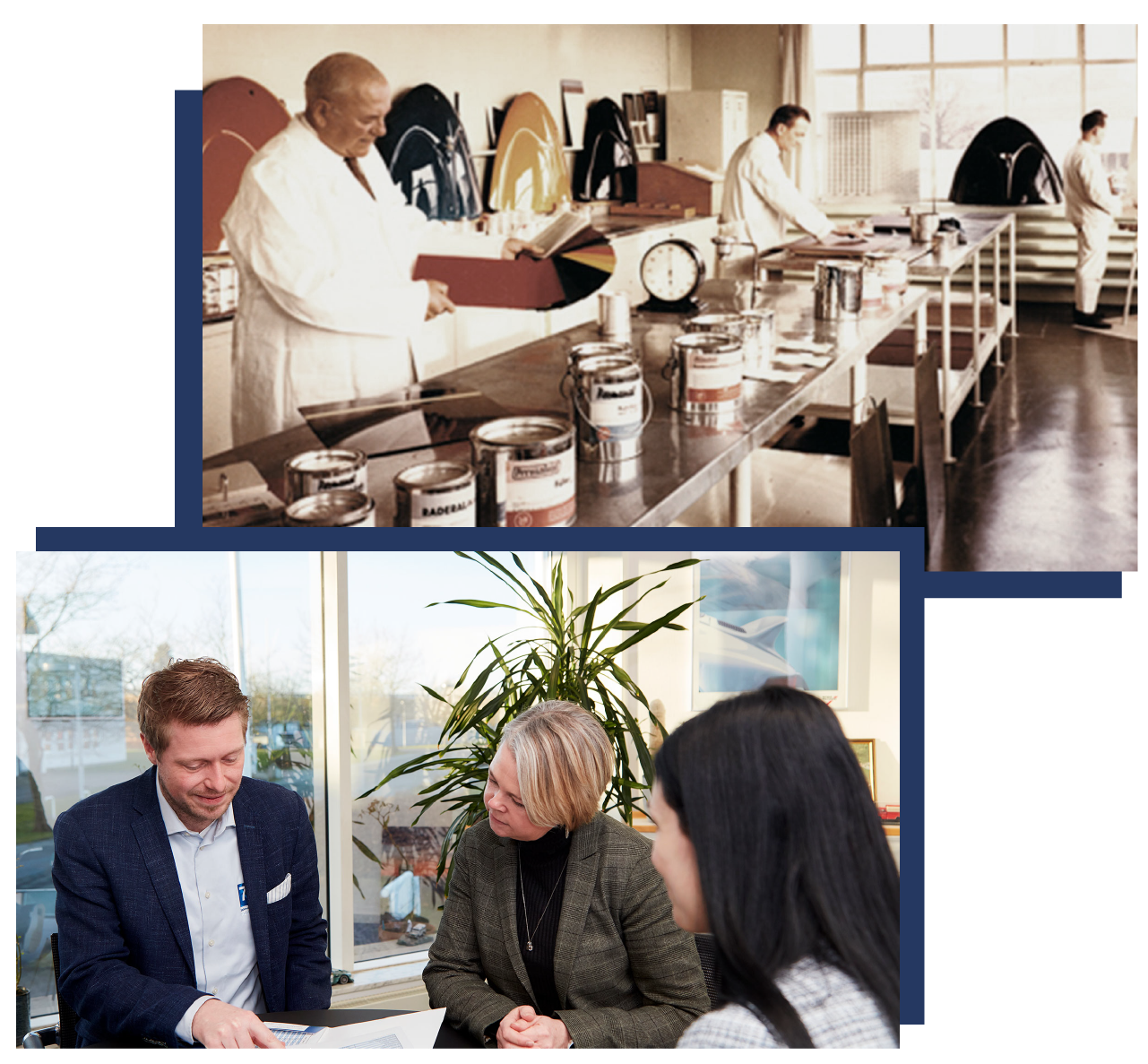
Baden-Jensen A/S was founded in 1944 by brothers Hans Jørgen Baden-Jensen and Niels Baden-Jensen in a small rented shop in Søborg, selling paint and coatings at a time when such goods were hard to come by. The company grew into a specialist wholesaler serving the automotive refinishing and industrial coatings markets, building lasting partnerships with leading European manufacturers along the way.

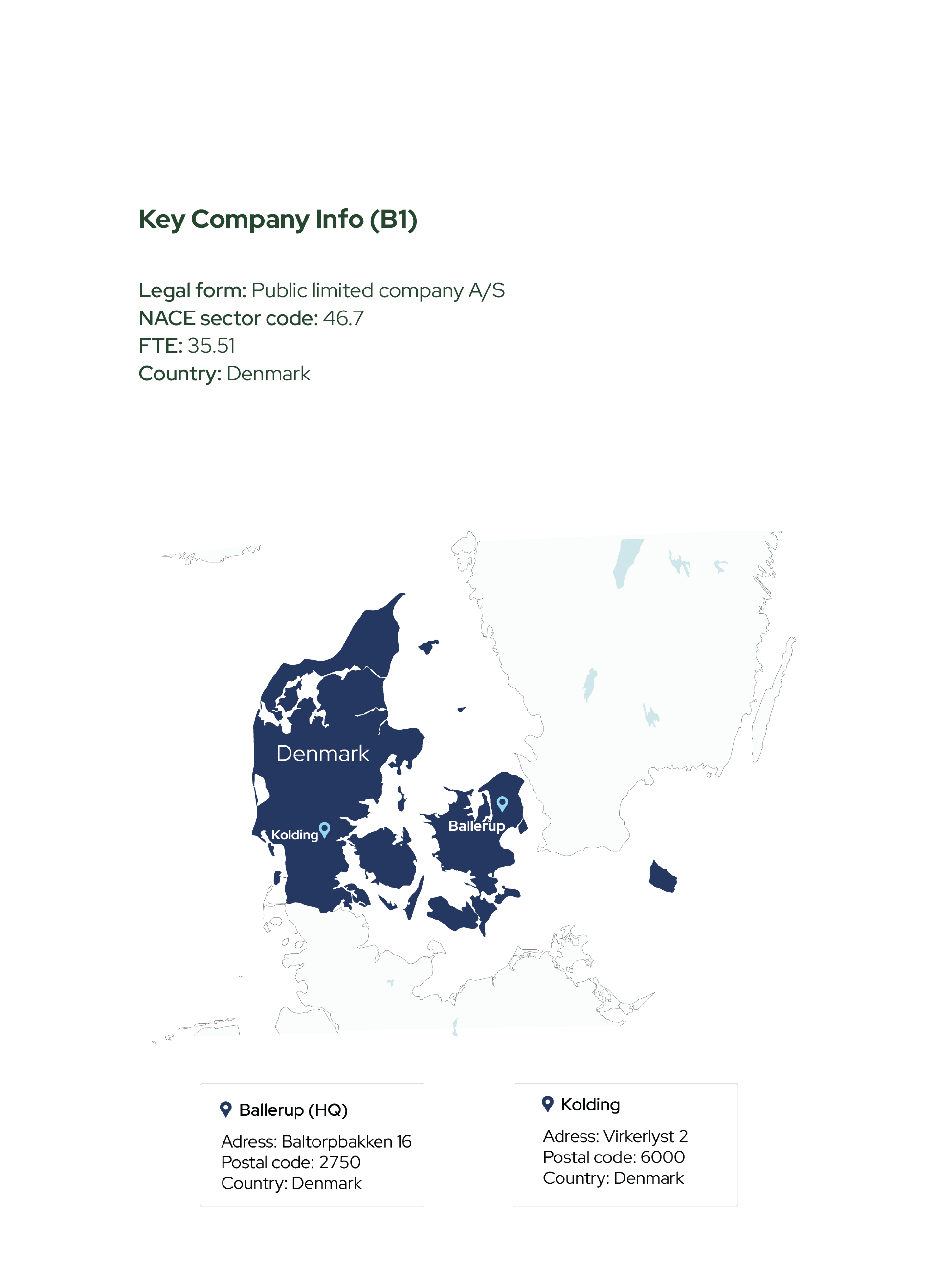
Over three generations of family ownership, Baden-Jensen A/S  has expanded from a single counter into a nationwide supplier operating from two branches in Ballerup and Kolding, serving customers across Denmark. In recent years, Baden-Jensen A/S  has evolved beyond coatings to offer digital solutions that help customers streamline their work. This focus on data-driven business development, automation, and creating real value for customers continues to shape how we work, and it underpins our commitment to running a responsible, sustainable, and forward-looking business.

Practices, policies and future initiatives for the transition to a more sustainable economy (B2)

(a) Practices

Baden-Jensen works to reduce the environmental impact of its activities and prevent pollution through practical measures in daily operations. This includes the ongoing transition of company cars to electric vehicles, with all new company cars ordered as electric since 2023. We also work with responsible handling of products containing solvents. For example, mixing-plant cans are emptied and allowed to cure before disposal, so they can be handled as non-hazardous waste. 

Resource use is monitored on an ongoing basis. Electricity, district heating, gas and water consumption are tracked for the Ballerup and Kolding locations, and recyclable waste such as clear plastic, cardboard, paper and metal is registered separately from waste sent to incineration. New products are reviewed before approval to ensure compliance with relevant requirements, including REACH, Danish MAL codes, CE marking where applicable and national legislation. The approval process also includes an environmental assessment and Danish safety data sheets. 

For employees, Baden-Jensen focuses on good working conditions, equal treatment, collaboration and the prevention of work-related injuries and accidents. The company supports employee development through targeted competence development, including training related to sustainability, safety and product knowledge.

(b) Policies

Baden-Jensen’s main policy framework is the combined Environmental and Quality Policy. The policy is part of the company’s management system, which is certified according to ISO 14001:2015 and ISO 9001:2015. The policy is reviewed annually as part of management’s evaluation. The policy is supported by more specific procedures and instructions, including procedures for air pollution, product approval, chemical handling, waste sorting and other relevant quality and environmental processes. As part of its sustainability work, Baden-Jensen links its objectives to selected UN Sustainable Development Goals. The SDGs are used to support prioritisation and communication of the company’s efforts, while the operational targets are followed through the company’s own management and reporting processes. The Environmental and Quality Policy is publicly available and can also be provided on request.

(c) Future initiatives and forward-looking plans
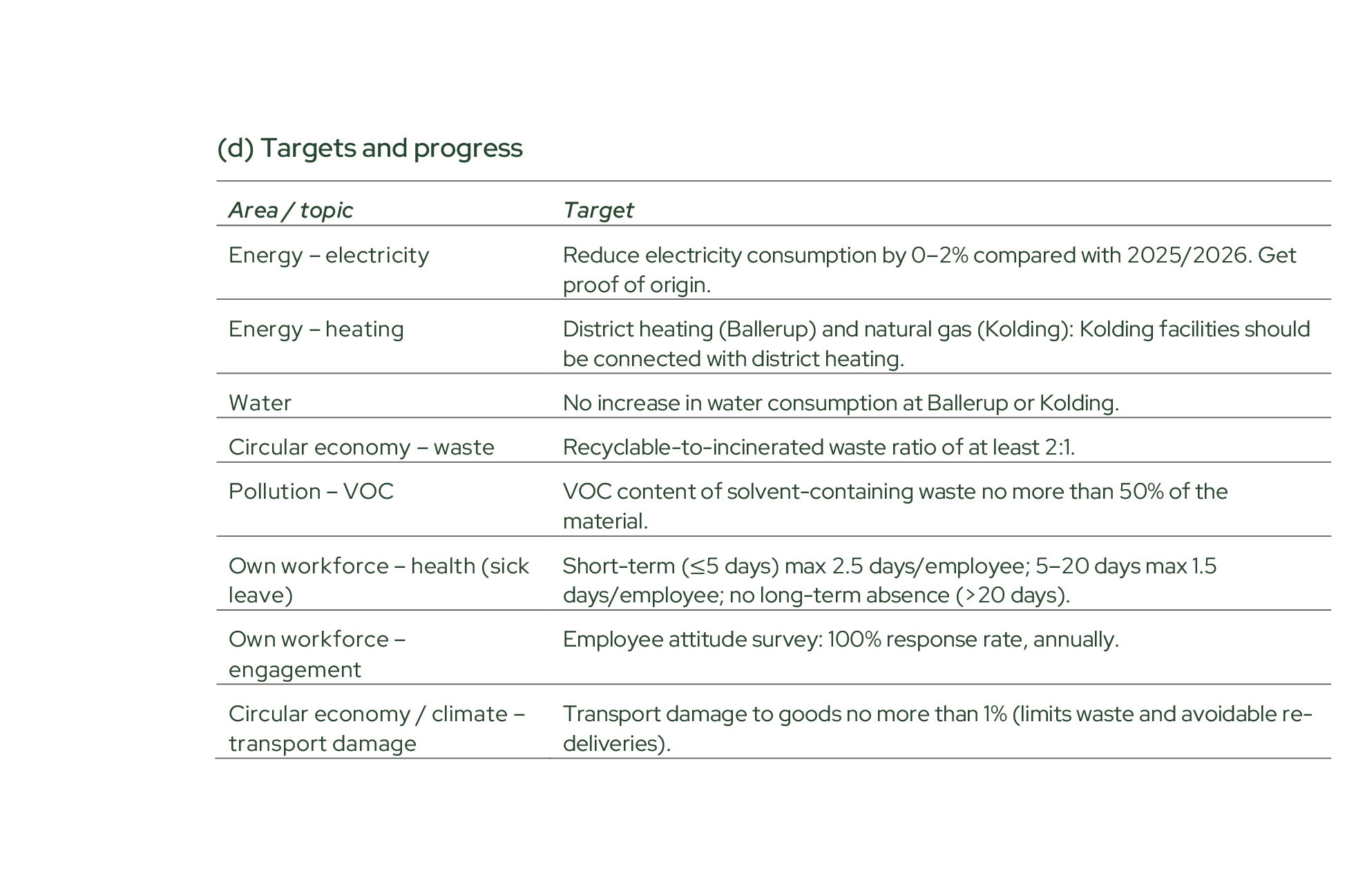
Baden-Jensen has set operational environmental and quality objectives with assigned responsibilities and deadlines. The current targets cover areas such as energy, water, waste, sick leave, delivery reliability, transport damage and supplier complaints.
Going forward, the company will continue to work with practical improvements in daily operations, including energy and resource efficiency, waste sorting, safe product handling, supplier follow-up and products with a stronger environmental profile.


ISO CERTIFICATION

Baden-Jensen has held environmental certification under the internationally recognised ISO 14001 standard since 2009, upgraded to ISO 14001:2015 in September 2018. The company is also certified to the ISO 9001:2015 quality standard, following a thorough review of its working processes. Together, these standards ensure that we meet all relevant environmental requirements and regulations, maintain consistent and high-quality processes, and continuously improve how we manage both quality and the environment. Both certifications were successfully recertified in 2024, confirming that our management systems remain robust and effective for our customers and other stakeholders.  In 2026/27 we plan to upgrade to ISO 9001:2026 and ISO 14001:2026, reflecting our ongoing commitment to developing the company and its processes. 

Sustainable Development Goals (SDGs)

The UN's Sustainable Development Goals give the world a shared language for sustainability, but not every goal is equally relevant to a company of our size and sector. Rather than claim a broad ambition we cannot yet back up, we have chosen to focus on the goals where Baden-Jensen is already taking concrete action — and where, as an automotive-refinish distributor, we have a genuine ability to make a difference. Following the SDG Compass approach, we mapped these goals across our value chain, distinguishing the stages where we can increase a positive impact from those where our priority is to minimise a negative one.

Where we raise a positive impact

Two goals sit at the people-facing front of our business, concentrated in our own operations and our relationship with suppliers. Through SDG 5 (Gender Equality) we work to open our trade — historically male-dominated — to more women. We apply equal-pay and inclusive recruitment practices across the company, addressing targets 5.5 and 5.6. Through SDG 8 (Decent Work and Economic Growth) we focus on the quality of the jobs we provide. Safe, fair employment and ongoing training underpin this commitment, alongside resource-efficient operations. This goal speaks to targets 8.4, 8.5 and 8.8, covering resource efficiency, full and productive employment with equal pay, and the protection of labour rights and safe working environments.

Where we minimise a negative impact

Three goals address the environmental footprint that runs through our supply, distribution and end-of-life stages. Through SDG 6 (Clean Water and Sanitation), we recognise that the chemicals and coatings we handle carry a pollution risk. Dedicated dry and wet storage and spill-prevention plans protect water from contamination at our sites and in handling, supporting targets 6.3 and 6.4. Through SDG 13 (Climate Action), we tackle the emissions tied to moving products. By consolidating freight and working with cleaner carriers, we cut transport-related CO₂ across our distribution chain — action aligned with targets 13.2 on integrating climate measures into how we plan and operate. Through SDG 12 (Responsible Consumption and Production), we work to keep materials in use and out of landfill: recycling all waste, switching to reusable pallets and managing chemicals soundly. This spans targets 12.4 to 12.7, from environmentally sound chemical and waste management to sustainable procurement.

A goal that connects them all

Finally, SDG 17 (Partnerships for the Goals) cuts across our entire value chain. We cannot reach these goals alone — most of our footprint sits in Scope 3, beyond our direct control. We therefore collaborate with partners including Teknologisk Institut, College 360, Marius Pedersen and Pallekonceptet, as well as our own suppliers. This partnership-led approach, reflecting target 17.16, is what makes the rest of our SDG work possible.

Gender Equality

We must achieve gender equality and strengthen the rights and opportunities of women and girls
Rent Water and Sanitation

We must ensure sustainable access to and management of water and sanitation for all
Decent Jobs and Economic Growth

We should promote sustained, inclusive, and sustainable economic growth, full and productive employment, and decent work for all
Responsible Consumption and Production

We need to ensure sustainable consumption and production
Climate initiative

We must act quickly to combat climate change and its consequences
Partnerships for Handling

We must revitalize the global partnership for sustainable development and strengthen the means to achieve the goals
Our environmental approach

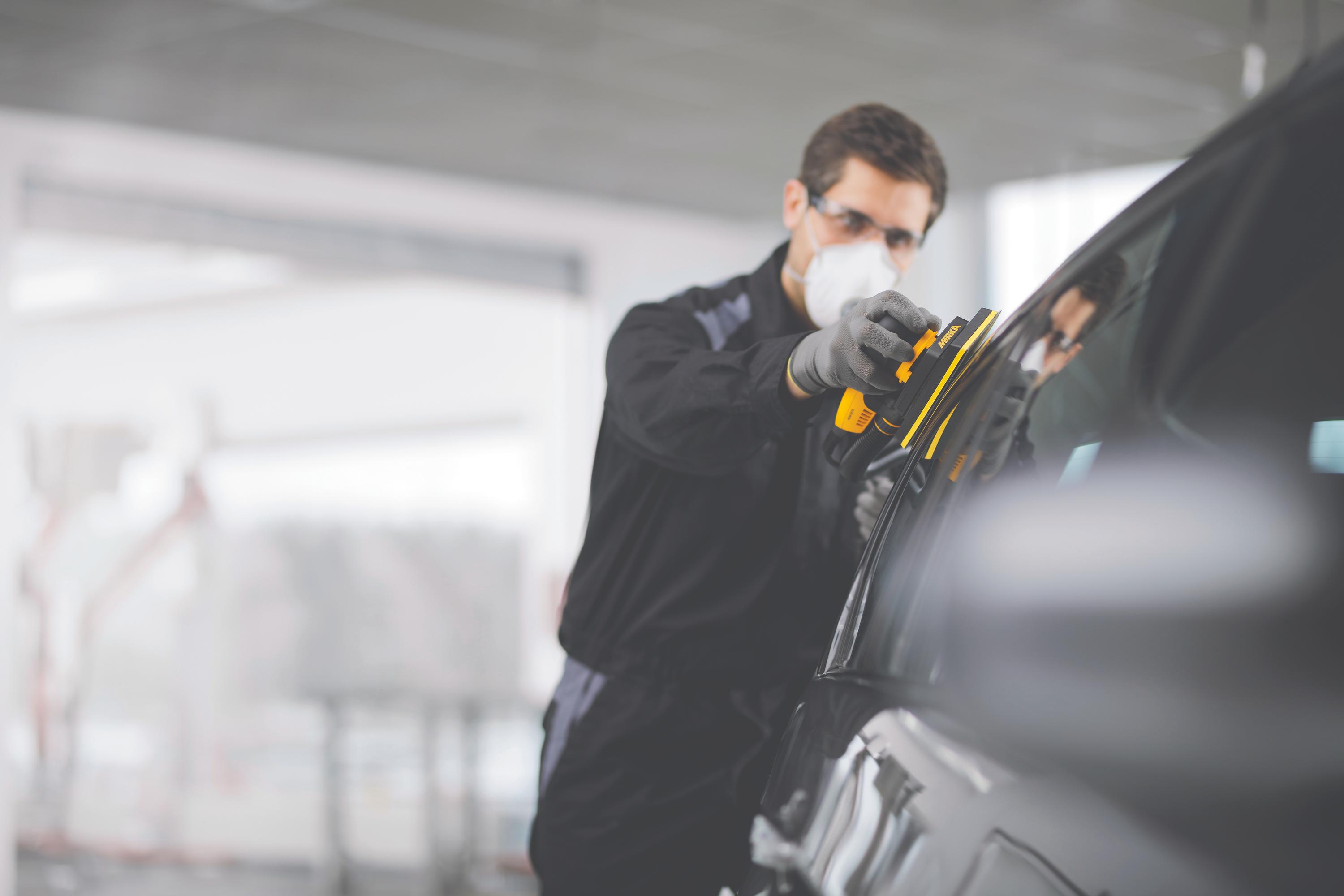
At Baden-Jensen, environmental responsibility is closely connected to our role as a supplier of automotive paint, equipment, services and technical guidance. Our work is focused on reducing emissions from our own operations, using resources responsibly and supporting safe handling of products and materials throughout the value chain. Our direct environmental impact is mainly linked to our buildings in Ballerup and Kolding, company vehicles, electricity, heating, water use and waste. At the same time, an important part of our wider impact is connected to the products we purchase and sell, packaging, suppliers, transport and the way our customers use and handle products.

Pollution prevention is especially relevant because many products in our industry require correct handling, storage and documentation. We work with safety data sheets, product approval, chemical handling procedures, emergency preparedness and customer training to reduce risks related to incorrect use or disposal. No separate pollutant emissions to air, water or soil have been identified for the reporting year. Our known locations have also been screened for protected and biodiversity-sensitive areas, and no sites were identified as located in or directly adjacent to such areas.

CO2e scope 1

102

ton

2025/2026

CO2e scope 2 location-based

23.3

ton

2025/2026

Location-based CO2 intensity

The company's location-based CO2 emissions in relation to turnover

Location-based CO2 intensity

~0.00

ton/DKK

2025/2026

Climate accounting (B3)
We have mapped our Scope 1 and Scope 2 greenhouse gas emissions for the reporting year. Scope 1 covers direct emissions from sources we control, including company vehicles and natural gas. Scope 2 covers indirect emissions from purchased energy, including electricity and district heating. Our greenhouse gas intensity is calculated as Scope 1 and location-based Scope 2 emissions divided by turnover in DKK. Because the intensity is calculated per single DKK of turnover, the result is very small and is shown as approximately 0 tCO₂e/DKK. 

CO2e Scope 3

135

ton

2025/2026

Scope 3 and value chain emissions

We have started mapping selected Scope 3 emissions linked to activities outside our direct operations. For Baden-Jensen, Scope 3 is especially relevant because we are a supplier and distributor, and a large part of the environmental impact is expected to sit in the value chain. The currently mapped Scope 3 figure includes the categories where data was available for this reporting year, such as selected transport, waste treatment and purchased office supplies. The figure should therefore not be interpreted as a complete value chain footprint.

The largest future data gaps are expected to relate to supplier-specific emissions data, packaging, inbound transport and product documentation. These areas are important because they are closely linked to our role as a full-service supplier and to our ambition to develop a greener product catalogue. Going forward, the most useful next step is to strengthen value chain mapping and decide which suppliers, product groups and transport data should be prioritised first. This will make future Scope 3 reporting more complete and more useful for decision-making.

Transport and company vehicles

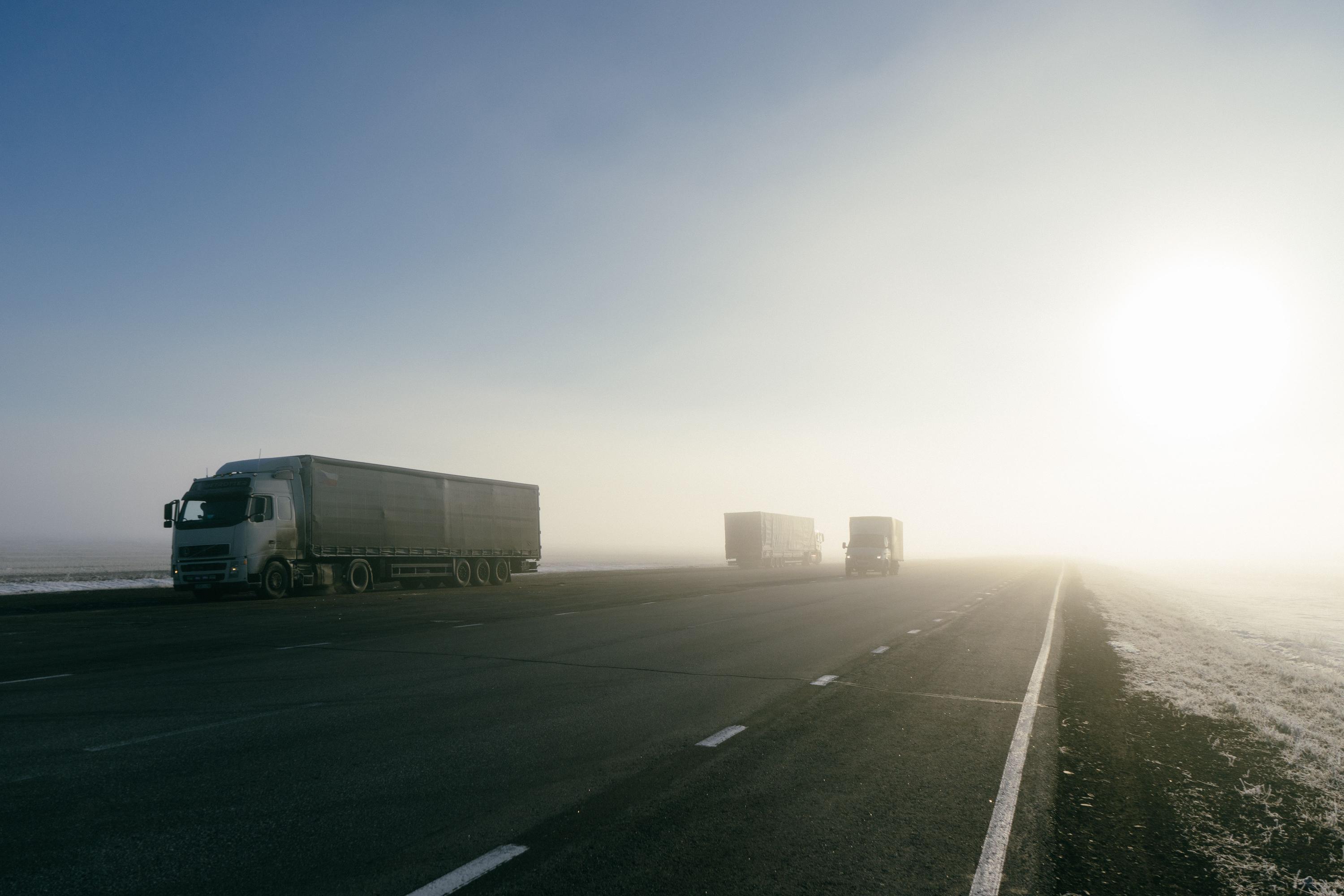
Transport is the area where we have made the clearest emissions reduction in this reporting period. Over the last years, we have replaced a large share of diesel vehicles with electric vehicles. This transition has reduced emissions from diesel and petrol vehicles and shifted part of the company’s transport energy consumption to electricity. As a result, transport-related Scope 1 and Scope 2 emissions have fallen significantly compared with previous years.

The current data shows that the transition to electric vehicles is an important lever for reducing direct emissions from the company’s own operations. Continued tracking of vehicle kilometres, fuel consumption and charging electricity will improve the accuracy of future reporting.

Share of green cars

73.3

%

2025/2026

Vehicle emissions by year

Energy consumption

961

MWh

2025/2026

Energy consumption from fossil sources

562

MWh

2025/2026

Share of renewable energy

42%

2025/2026

Energy consumption

Our energy consumption is linked to electricity use, district heating in Ballerup, natural gas heating in Kolding and fuel or electricity used for transport. Electricity consumption is based on actual consumption data. The renewable share is calculated using the Danish electricity mix and natural gas is treated as Danish grid gas, where the renewable share reflects the average biogas share in the Danish gas system. District heating is calculated using supplier-specific information. Future work should focus on reviewing electricity and heating consumption by location and assessing alternatives to natural gas heating in Kolding, including district heating once a regional connection becomes available.

Water consumption

183

2025/2026

Water (B6)

Water is not currently assessed as one of our largest environmental impact areas, but it remains relevant to monitor as part of our environmental management. Our water consumption has decreased continuously over the last few years. This development is linked to increased awareness of water use within the company and ongoing attention to resource consumption in daily operations. We will continue to monitor water consumption and use the data as part of our broader resource overview.

Resource use, circular economy and waste management (B7)

Waste sorting and circular practices are established focus areas at Baden-Jensen. Our main waste fractions are cardboard and paper, plastic, metal, clean untreated wood and combustible waste. We work with circular economy principles through waste sorting, recycling, pallet reuse and responsible handling of materials. As a distributor, our material flows are closely linked to incoming products, packaging, outgoing goods and product-related waste streams.

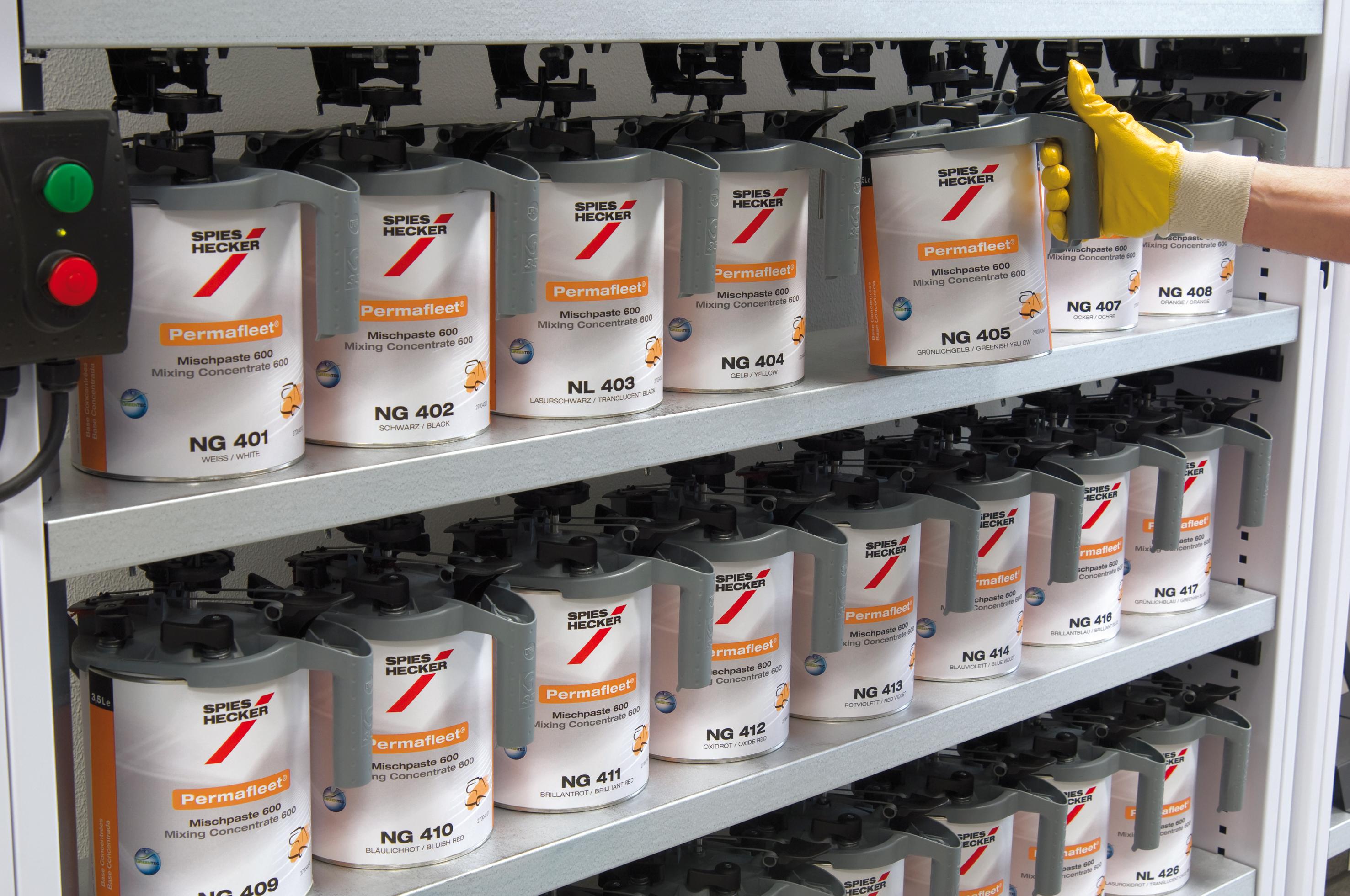
We have strengthened our circular practices through partnerships with Marius Pedersen for recycling and Pallekoncept for pallet reuse. We also reuse cardboard boxes from suppliers as packaging for customers where possible. We have previously explored options for recycling paint residues, including through collaboration with external partners. Although the technology is not yet mature enough for full implementation, the work supports our broader ambition to identify circular opportunities in our industry. In parallel, we are working with a greener product catalogue with products that have lower CO₂e emissions and fewer hazardous chemicals. This supports both circular economy and pollution prevention by helping customers choose products with a lower environmental impact.

The available waste data shows that we met our internal goal that recyclable waste should be at least twice the amount of combustible waste. Going forward, the focus should be on maintaining this performance, strengthening sorting quality in daily practice and improving the link between waste data, packaging data and purchasing data.

Amount of waste generated

17,716

kg

2025/2026

Amount of hazardous waste generated

0.50

kg

2025/2026

Amount of waste prepared for recycling

12,641

kg

2025/2026

Our social approach

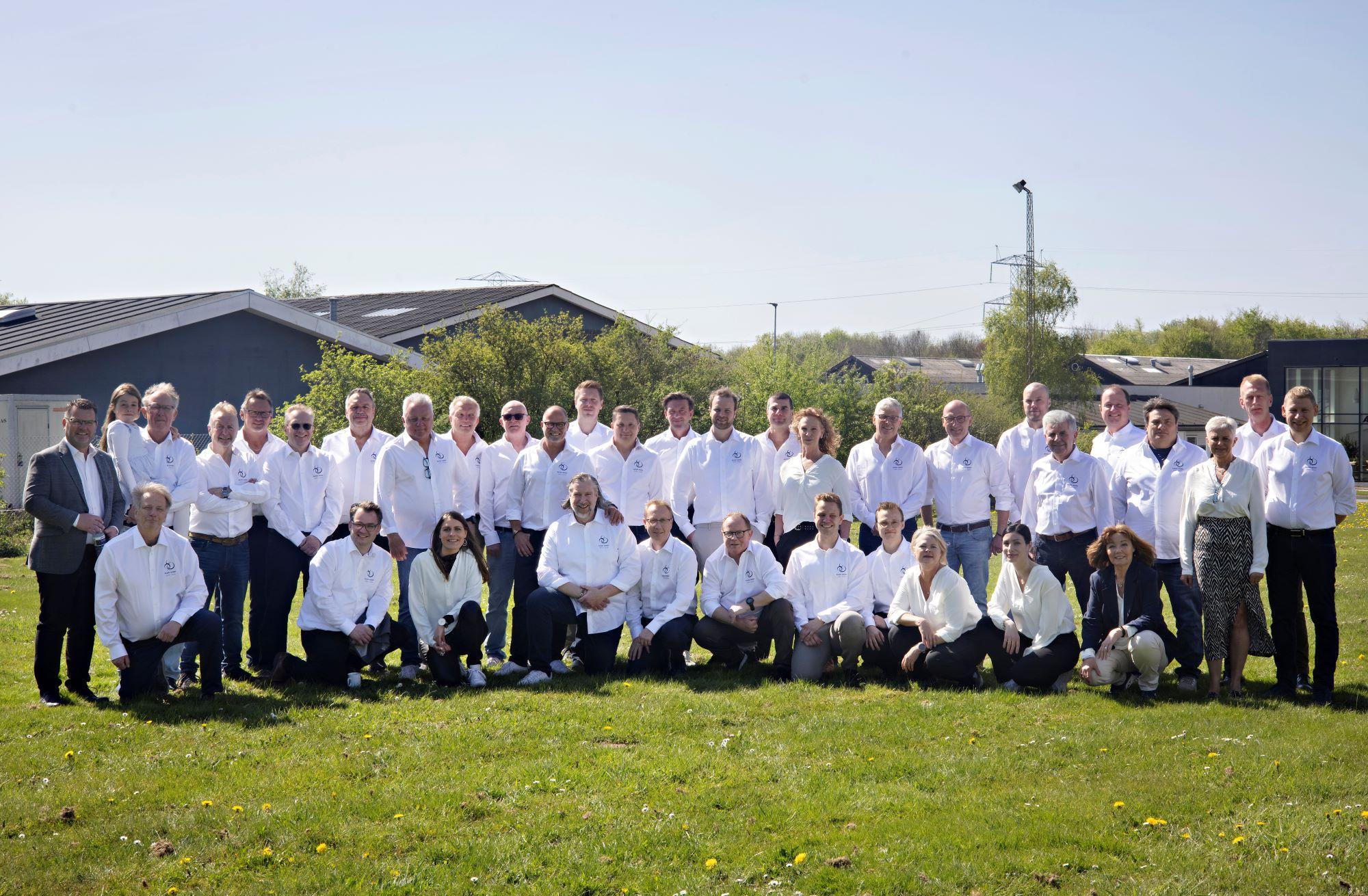
At Baden-Jensen, our social responsibility starts with the people who are part of our daily operations. As a family-owned company with a long history, we place importance on trust, long-term relationships and a workplace where employees feel valued, respected and able to contribute. Our employees’ knowledge and experience are central to the way we serve our customers. Product knowledge, technical understanding and safe handling are especially important in our industry, where customers rely on our guidance in the correct use of paints, chemicals, equipment and processes.

We work with employee wellbeing and development through ongoing dialogue, employee and management development reviews, workplace assessments, health and safety follow-up and shared forums across the organisation. As part of the automotive aftermarket, we operate in an industry that has traditionally been male-dominated. We therefore see diversity, equality and equal opportunities as important themes, both in our current workplace and in future recruitment.

Full-time employees

35.5

2025/2026

Female full-time employees.

15.3

%

2025/2026

Workforce profile (B8) 

Our workforce indicators give an overview of the size and composition of Baden-Jensen in the reporting year. We work to create a workplace where all employees have equal opportunities, regardless of gender, age, background or role. For us, equality is not only about representation, but also about ensuring fair conditions, respectful collaboration and opportunities for development.

The gender distribution reflects the structure of our business and the industry we operate in. We are aware that parts of the automotive aftermarket have traditionally had a higher share of male employees, especially in technical, warehouse and product-related functions. When recruiting, we want to support equal opportunities and attract a broad range of candidates.

Number of recordable work-related accidents

Number of recordable work-related accidents

0.00

2025/2026

Health, safety and wellbeing (B9)
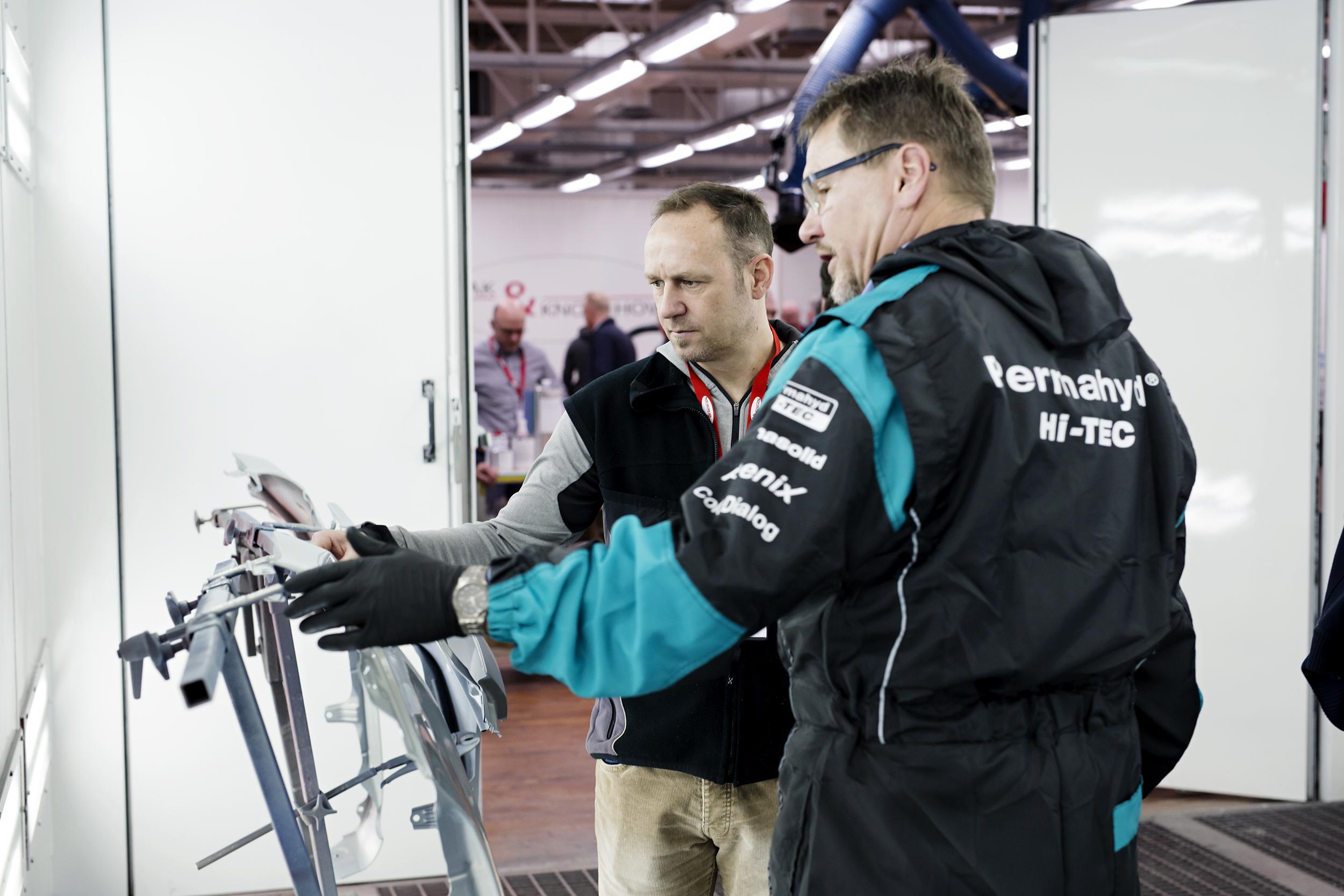
Health and safety is an important part of our responsibility as an employer. Our work includes both formal health and safety follow-up and practical improvements in everyday routines. During the reporting year, no recordable work-related accidents, work-related fatalities or traffic accidents with personal injury were registered.

Three minor workplace incidents were followed up internally. Although they did not result in sickness absence, they led to concrete preventive actions. Employees were reminded to use safety glasses during relevant work processes, and a special stacker was purchased to improve the handling of drums. We also monitor sickness absence and employee wellbeing as part of our broader workplace follow-up. This helps us maintain a healthy work environment and respond when there are signs that working conditions, routines or support need attention.

Average number of hours female employees have received training

49.5

2025/2026

Average number of hours male employees have received training

74.0

2025/2026

Training and development (B10)

Knowledge sharing and competence development are central to Baden-Jensen’s role as a full-service supplier. Our employees need strong product knowledge, technical understanding and awareness of safe handling, especially when working with paints, chemicals, equipment and customer guidance. Training takes place both through formal courses and through day-to-day knowledge sharing across the organisation. Some training is linked to specific job functions, particularly within warehouse, technical and product-related work, where safety, handling procedures and product knowledge are especially important.

Our training efforts also extend beyond our own workforce. Through our training activities, including the training centre in Middelfart, we help customers and future skilled professionals strengthen their knowledge of correct material handling, safe processes and efficient use of products. Employees are employed under individual employment contracts and Danish employment legislation, including Funktionærloven. No employees are covered by collective bargaining agreements.

Our governance approach

Baden-Jensen’s governance approach is based on long-term responsibility, trust and close relationships with customers, employees, suppliers and other business partners. As a privately owned company with more than 80 years of history, we focus on building a stable and responsible business over time. We want to be a value-creating partner for our customers and support them through honest advice, strong technical knowledge, training and reliable solutions.

Our values are customer focus, innovation and “best in class” technical know-how. They guide the way we work with customers, develop our services and cooperate across the value chain. Responsible governance also means having clear expectations for how we work internally and externally. Policies, procedures, defined responsibilities, board oversight and regular follow-up support quality, environmental responsibility, legal compliance, customer satisfaction and responsible business conduct. The purpose of our governance work is to ensure that responsibility is part of daily decision-making, not only something reported once a year.
Martin Baden-Jensen

Business conduct and integrity (B11)

Responsible business conduct is part of the way Baden-Jensen works with customers, suppliers, employees and other stakeholders. We expect business relationships to be based on trust, professionalism and compliance with applicable laws. Internally, this is supported by policies, procedures, confidentiality requirements and clear responsibilities. We also use a Code of Conduct for Business Partners and Suppliers, which sets expectations for responsible business practices. This includes expectations related to legal compliance, human rights, labour standards, environmental requirements and anti-bribery and anti-corruption principles.

For the reporting year, no convictions or fines related to corruption or bribery were registered.

Convictions for the violation of anti-corruption and anti-bribery laws

0.00

2025/2026

Presence at board meetings

100

%

2025/2026

Concluding comments

This report brings together Baden-Jensen’s current ESG work and gives us a clearer overview of where we stand today. The report focuses on the areas most relevant to our business: climate and energy, responsible resource use, chemical safety, circular practices, our own workforce, customer training and responsible business conduct.

The reporting process has strengthened our baseline for Scope 1 and Scope 2 emissions, energy consumption, transport, water, waste, workforce indicators, health and safety, training and governance. It has also shown where our data can become stronger, especially within Scope 3, supplier information, product data, packaging and transport.

We will continue to work with sustainability as part of our daily business. Our focus will be on continuing the transition of our vehicle fleet, reviewing energy use, strengthening waste sorting and circular practices, maintaining a safe and respectful workplace, supporting customer training and improving our understanding of value chain impacts.

The documentation behind the report is stored internally, including consumption data, HR and health and safety data, supplier documentation, management system documentation and calculation files. The report has not been externally verified, but it has been prepared on the basis of available internal documentation and will be used as a foundation for continued improvement.

Baseline Overview

This is an overview of all the data from the VSME Basis Baseline.

Introduction to the company

2025/2026

Master Data (B1)

2025/2026
Full-time employees
35.5
Size of the balance sheet
8.2831e7
Legal form
Public limited company (A/S)

Practices, policies and future initiatives for transitioning towards a more sustainable economy (B2)

2025/2026
Publicly available policies
Own workforce, Workers in the value chain, Pollution, Corporate governance, Consumers and end users, Climate change, Circular economy

Energy consumption (B3)

2025/2026
Electricity consumption
205 MWh
Electricity from non-renewable sources
150,012 MJ
Electricity from renewable sources
164 MWh
Energy consumption
3,460,320 MJ
Energy consumption from fossil sources
562 MWh
Energy sources
Natural gas, Electricity, District heating
Fuel consumption from renewable energy sources
143 MWh
Non-renewable fuel
1,154,952 MJ
Energy consumption from renewable sources
400 MWh
Total fuel consumption
1,669,464 MJ

CO2 (B3 - continued)

2025/2026
CO2e scope 2 location-based
23.3 ton
Location-based CO2 intensity
~0.00 ton/DKK
CO2e scope 1
102 ton

Pollution of air, water and soil (B4)

2025/2026

Biodiversity (B5)

2025/2026

Water (B6)

2025/2026
Water consumption
183

Resource use, circular economy and waste management (B7)

2025/2026
Amount of hazardous waste generated
0.50 kg
Amount of waste generated
17,716 kg
Amount of waste prepared for recycling
12,641 kg

Workforce (B8)

2025/2026
Departed employees
4.00
Employee turnover
11.3 %
Employees broken down by country - Denmark
35.5
Employees broken down by gender - Men
30.1
Employees broken down by gender - Women
5.45

Health and safety (B9)

2025/2026
All worked hours
12,050 hours
Number of recordable work-related accidents
0.00
Number of registered work-related fatalities
0.00

Remuneration, collective bargaining and training (B10)

2025/2026
Average number of hours female employees have received training
49.5
Average number of hours male employees have received training
74.0
Employees covered by collective bargaining agreements
0.00 %
The average hourly salary for female employees
337.0
The average hourly salary for male employees
301.0

Convictions and fines for corruption and bribery (B11)

2025/2026
Amount of fines for violation of anti-corruption and anti-bribery laws
0.0
Convictions for the violation of anti-corruption and anti-bribery laws
0.00

Comments on the report

The report is not verified by an independent third party. Although we have made efforts to ensure that the content of the report is accurate, there is no guarantee regarding its accuracy and/or completeness, and we therefore disclaim any liability for any damage or loss that may arise from actions taken based on the report.

Denne ImpactReport er lavet med Valified